7 Best Open Source Tabnine Alternatives
A curated collection of the 7 best open source and self-hosted alternatives to Tabnine in 2026.
Looking for a free, privacy-friendly, or self-hosted replacement for Tabnine in 2026? The top open-source alternative is OpenCode — Open source AI coding agent for developers.
Other highly rated open-source Tabnine alternatives include pi, Cline and Continue.

Open source AI coding agent for developers
OpenCode is an open-source AI coding agent designed to help developers write, debug, and manage code efficiently. It integrates seamlessly with your terminal, IDE, or desktop app, providing real-time assistance powered by advanced AI models. - Multi-Model Support: Connect to any AI model from providers like Claude, GPT, or Gemini, or use local models. - LSP Integration: Automatically loads the right Language Server Protocols (LSPs) for the LLM to enhance coding accuracy. - Multi-Session Workflows: Run multiple agents in parallel on the same project for complex tasks. - Shareable Sessions: Generate shareable links for debugging or reference, ideal for team collaboration. - Editor Agnostic: Available as a terminal interface, desktop app (macOS, Windows, Linux), and IDE extensions. - Privacy-First Design: Does not store your code or context data, ensuring compliance with sensitive environments. - GitHub Copilot Integration: Log in with GitHub to use your existing Copilot account. - OpenAI Integration: Use your ChatGPT Plus or Pro account directly within OpenCode. - Zen Models: Access handpicked, benchmarked models optimized specifically for coding agents. OpenCode is open-source and can be self-hosted for full control over your data and infrastructure. It supports integration with 75+ LLM providers through Models.dev, including local model deployment. The desktop app is available for macOS, Windows, and Linux, while the terminal interface and IDE extensions provide flexibility across development environments.

Minimal terminal-based AI coding agent
Pi is a minimal agent harness designed for developers who want to adapt AI workflows to their own processes rather than the other way around. It runs in the terminal and offers powerful customization through extensions, skills, prompt templates, and themes. - Minimal & Customizable: Skip bloated features like sub-agents and plan mode. Build exactly what you need. - Multi-Model Support: Switch between 15+ providers (Anthropic, OpenAI, Google, Ollama, etc.) mid-session with /model or Ctrl+L. - Tree-Structured History: Sessions are stored as trees. Navigate to any prior point with /tree, export to HTML, or share via GitHub gist. - Context Engineering: Load project-specific instructions via AGENTS.md, SYSTEM.md, and skills. Customize compaction strategies. - Four Operational Modes: Interactive, print/JSON, RPC, and SDK for programmatic usage. - Extensible Architecture: Add custom providers, models, and UI tweaks via extensions. Bundle as Pi packages and share via npm or git. - Token Efficiency: Minimal system prompt ensures efficient token usage. Pi is open source and can be self-hosted. Installation options include: bash curl -fsSL https://pi.dev/install.sh | sh powershell -c "irm https://pi.dev/install.ps1 | iex" npm install -g --ignore-scripts @earendil-works/pi-coding-agent pnpm add -g --ignore-scripts @earendil-works/pi-coding-agent bun add -g --ignore-scripts @earendil-works/pi-coding-agent Pi supports custom installations and can be extended with third-party packages like @termdraw/pi for enhanced TUI capabilities.

Open-source AI coding agent for developers
Cline is an open-source AI coding agent designed to help developers understand, refactor, and automate codebases directly within their IDE, terminal, or SDK. It supports Plan and Act modes for strategic execution, integrates with MCP for tool access, and works with any model—Claude, GPT, Gemini, or local models like Ollama. - Cross-Platform Edits: Coordinated multi-file changes with linter-aware fixes, diffs, and one-click undo. - Terminal Execution: Runs bash commands and reacts to output in real-time, handling long-running processes like dev servers and tests. - Plan & Act Modes: Toggle Plan mode to align on strategy, then Act to execute with approval or autopilot. - Custom Rules & Skills: Define .clinerules to teach the agent your coding standards, architecture, and deployment conventions. - Model Flexibility: Use any model—Claude, GPT, Gemini, local Ollama/LM Studio, or OpenAI-compatible endpoints. Bring your own keys or weights. - MCP Integration: Extend functionality with the Model Context Protocol (MCP) for tool access and custom workflows. - IDE & CLI Support: Works in VS Code, JetBrains, Cursor, Windsurf, and via CLI for scripts, cron jobs, and CI pipelines. - Enterprise Ready: Trusted by global enterprises like Samsung, Salesforce, Oracle, Amazon, and Microsoft. Cline is open-source (Apache 2.0) and can be self-hosted. It supports local model integration (e.g., Ollama, LM Studio) and is compatible with any OpenAI-compatible endpoint. The CLI and SDK allow embedding Cline in custom workflows or products.
Open-source coding agent for developers

Continue was an open-source coding agent designed to amplify developers rather than replace them. The project has been acquired by Cursor, but its open-source codebase remains freely available as a foundation for others. - Open-source coding agent for developers - Focused on amplifying developer productivity - Extensible and customizable architecture - Community-driven development model - Remains available as an open-source foundation post-acquisition - Open-source codebase available on GitHub - Self-hosting options remain viable - Compatible with various development environments
Open source AI coding agent with 500+ models, bring-your-own-key support, and specialized modes for writing, debugging, and planning code across IDEs and CLI.
Open source AI coding agent with 500+ models, bring-your-own-key support, and specialized modes for writing, debugging, and planning code across IDEs and CLI.

Open-source self-hosted AI coding assistant
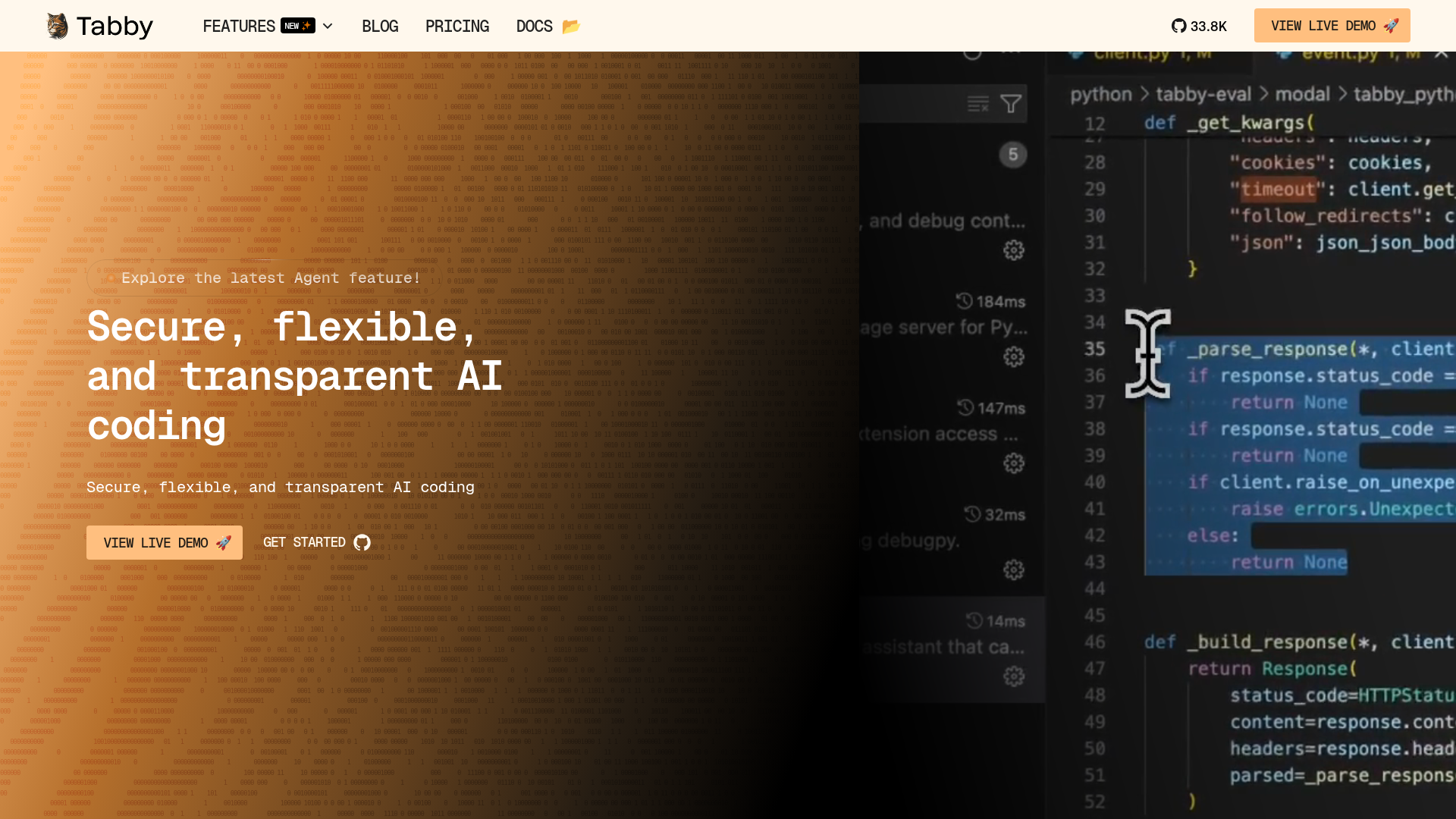
Tabby is an open-source AI coding assistant designed to help developers code faster and smarter. It provides secure, flexible, and transparent AI-powered coding assistance with features like code completion, inline chat, and an answer engine—all while ensuring data privacy through self-hosting. - Code Completion: AI-powered suggestions that predict and complete your next coding move. - Inline Chat: Real-time AI chat directly within your code editor for instant assistance. - Answer Engine: Get instant coding answers without leaving your IDE. - Data Connectors: Connect data sources to enable smarter AI assistance tailored to your projects. - Agent (Pochi): A full-stack AI teammate that plans, executes, and checks tasks like a human developer. - Self-Hosting: Deploy Tabby on your own infrastructure for full control over data and privacy. - Multi-Model Support: Compatible with various AI models for flexibility in model choice. - IDE Integration: Works seamlessly with popular IDEs like VS Code, JetBrains, and more. Tabby is open-source and can be self-hosted on your own servers or cloud infrastructure. It supports deployment via Docker, Kubernetes, and direct installation. The platform is designed for scalability, security, and customization, making it suitable for teams and enterprises that prioritize data privacy and control. Documentation and setup guides are available for easy deployment and management.

AI-powered developer platform for code hosting and collaboration
GitHub is the leading platform for software development, offering version control, project management, and collaboration tools. Built for developers, teams, and enterprises, it combines Git hosting with AI-powered features like GitHub Copilot for code generation and advanced security tools to streamline development workflows. - AI-Powered Development: GitHub Copilot for AI-assisted code writing and refactoring - Code Hosting & Version Control: Git repository management with pull requests and branching - Automated Workflows: GitHub Actions for CI/CD and workflow automation - Code Security: Advanced Security features for vulnerability detection and secret protection - Dev Environments: Codespaces for instant cloud-based development environments - Project Management: Issues, project boards, and tracking for agile workflows - Collaboration Tools: Team-based code reviews, discussions, and documentation - Enterprise Solutions: Scalable platform with premium support and security features GitHub is a cloud-based platform with no self-hosting option. It provides enterprise-grade security, compliance certifications (including SOC 2, ISO 27001), and GDPR compliance. The platform is built and maintained by GitHub, Inc. (a Microsoft subsidiary) with data centers globally.
About Tabnine
Tabnine is an AI code assistant designed to enhance software development through intelligent coding agents, completions, and chat interfaces. Built for enterprise environments, Tabnine prioritizes code privacy, security, and compliance while providing organizational context to make AI reliable and effective.
Key Features of Tabnine
- AI Coding Platform: Delivers AI chat, completions, and agentic workflows across IDEs and CLI for streamlined development.
- Enterprise Context Engine: Provides organizational intelligence to give AI agents system-level understanding of your unique architecture, frameworks, and coding standards.
- Code Privacy & Security: Ensures total code privacy with zero data retention and protects against IP issues through code scanning and license-compliant models.
- Multi-Environment Deployment: Supports SaaS, on-premises, and air-gapped deployments for maximum control and compliance.
- Centralized Control Plane: Offers visibility, access controls, policy enforcement, and auditability across users, teams, and workspaces.
- CLI Integration: Enables AI-powered coding, automation, and agents directly in the terminal.
- SDLC Support: Provides AI chat that supports the entire software development lifecycle.
Tech / Self-Hosting
Tabnine offers flexible deployment options including cloud-based SaaS, on-premises, and fully air-gapped environments. The platform is designed to integrate seamlessly with existing development workflows and supports enterprise-grade security and compliance requirements.